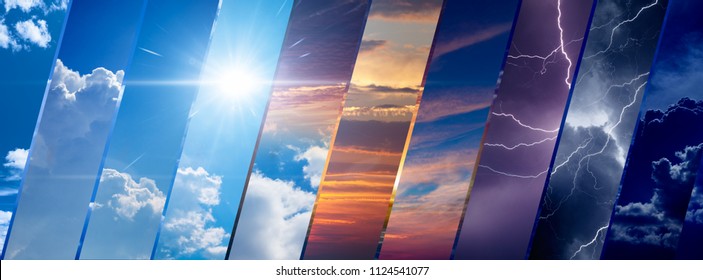
“The weather” refers to how hot or cold, wet or dry, calm or stormy, clear or cloudy it is that day.
The weather is influenced by the state of the atmosphere and the Earth’s position from the Sun.
What’s your favourite kind of weather? Here are some things to consider:
Temperature: Very Cold, Chilly/Brisk/Refreshing, Comfortable/Not hot or cold, Warm, or Very Hot
Precipitation: None, Rain, Snow, Hail
Sky: Clear Sky, Cloudy, Foggy
Everyone has different preferences when it comes to the weather. There are no wrong answers! I like this quote:
Weather affects more than just what we will wear that day. Day-to-day weather shapes our physical environment, which influences our lifestyles and culture.
Unexpected changes in the weather and climate can impact our culture. For instance, many of us would feel sad if there wasn’t snow on Christmas. There are lots of songs about it!
But what is the difference between weather and climate?
Weather refers to day-to-day temperature and precipitation. Climate is the term for the average kinds of atmospheric conditions that take place over longer periods of time.
Over thousands of years, changes in Earth’s orbit can affect the amount and distribution of solar energy received by the Earth. This influences long-term climate and global climate change.
How Does Weather Work?
Most weather phenomena occur in the lowest level of the atmosphere, the troposphere, just below the stratosphere.
Weather is driven by air pressure, temperature and moisture differences between one place and another.
These differences can occur due to the sun’s angle at any particular spot, which varies with latitude.
Because the Earth’s axis is tilted relative to its orbital plane, sunlight is incident at different angles at different times of the year.
On Earth’s surface, temperatures usually range from −40°C to 37°C annually. Since we’re in the Northern hemisphere, our temperatures are often below −40°C. What’s the coldest temperature that you remember being in? What’s the hottest?
This explanation will make more sense once you see it with visuals. According to YouTube comments, these videos do the best job of explaining the weather in a clear and engaging way. Let’s watch them together!
Recently, I learned that “50% chance of rain” does not mean that there is a 50/50 chance that it will rain! I didn’t understand it until I watched this video.
So far, we have been talking about “normal” weather. Now let’s talk about extreme weather!
Here are some incredible examples of extreme weather. The first one shows winds that are so powerful, that they are blowing a waterfall in the opposite direction!
If you want to see even more, National Geographic has a whole documentary about extreme weather. Here is the trailer:
I thought we could begin class by watching some of the best moments of Matthew Perry on TV.
Matthew began acting when he was a teenager. He had an early career that was filled with small parts and not very successful show pilots.
His fame skyrocketed in the mid-1990s with the Emmy nominated role of Chandler Bing on this mass hit sitcom Friends.
He starred in movies like Fools Rush in and The Whole Nine Yards.
Matthew struggled with addiction for many years.
He attempted to replicate his sitcom success with Friends with a show called Studio 60 On the Sunset Strip and Go On.
Eventually he achieved ratings success with a take on the show The Odd Couple.
He was never married or father.
Childhood and Parents
His full name is Matthew Langford Perry.
He was born on August 19, 1969, in Williamstown, Massachusetts.
His father was an actor named John Perry. He split up with his mother Suzanne Langford when Matthew was still a small infant.
He went to live with his mother in Ottawa, Canada.
Suzanne served as press secretary to Canadian Prime Minister Pierre Trudeau and later remarried. Matthew’s stepfather was Keith Morrison, and he was a correspondent for NBC’s Dateline Program.
Matthew attended Rockcliff Park Public School and became friends with fellow student Justin Trudeau who is the current Prime Minister of Canada.
After he moved to Los Angeles around the age of 15, he lived with his father. Matthew enrolled in at Buckley School. He graduated from the private school in 1987.
While he was growing up Matthew had two passions in life. They were playing tennis and acting. Matthew said in 2012 “I was a very good tennis player in Ottawa, Canada, nationally ranked when I was like 13. Then I moved to Los Angeles when I was 15 and everyone in LA just killed me. I was pretty great in Canada not so much in Los Angeles.”
But a career in acting proved to be a very different story.
Early Roles
Matthew landed his first movie part while he was in high school.
It was a supporting role opposite River Phoenix in the movie called in A night In the Life of Jimmy Reardon. It was in 1988.
Unfortunately, the film did not do very well.
In September 1987, he starred in his first sitcom called Second Chance.
The show starred Kiel Martin who started as a man who dies and gets the chance to go back to mentor a younger version of himself.
The younger version of himself was played by Matthew. This show was later remade dropping Martin’s character and focusing on the teenage misadventures of Matthew’s character.
The new show was called Boys Will Be Boys. However, this show didn’t attract enough of an audience to stay on the air.
After the series ended Matthew landed a series of small parts and guest appearances on programs such as Empty Nest and Growing Pains and 90210.
He also had a supporting role on the short-lived Valerie Bertinelli comedic show called Sydney in 1990.
That same year Matthew gave a strong performance as Dezi Arnez Junior in the television show called Call Me Anna which was about the life of actor Patty Duke.
Three years later in 1993 he tried his sitcom success again with the show called Home Free.
In this show he started as a young reporter who lives at home with his mother, sister and her two kids. However, after a few months on air the show was cancelled.
Friends Fame
Eventually Matthew found the perfect project when he got a leading role on a new sitcom about a group of young men and women in New York City.
Friends debuted in September 1994 and became one of the most popular television sitcoms of all time.
Matthew played the witty and sarcastic Chandler Bing shared an apartment with an aspiring actor named Joey played by Matt LeBlanc. He was also a longtime friend of Ross played by David Schwimmer. Courtney Cox played Monica. She was Ross’s sister. Jennifer Aniston played Rachel and she was Monica’s roommate and Lisa Kudrow played Phoebe. She was the kooky friend of everyone in the show.
The six actors were friends and were very close both on and off the screen.
They all came together to renegotiate their contracts after Friends became a huge hit and was a must watch show for everyone to watch on Thursday night.
Eventually when the contract was finalized each cast member earned $1 million per episode. The critics love the show too.
Friends earned 62 Emmy Award nominations during the shows’ time on the air, including Perry’s 2002 nomination for Outstanding Lead Actor in a Comedy series.
In the later seasons of friends Chandler developed a romantic relationship with Monica.
They eventually got married, adopted twins and planned to move to the suburbs as the series came to an end in May 2004 after a decade on the air.
I thought we could watch a little clip of the Friends reunion in 2021.
Addiction
Even though he enjoyed the extreme popularity of Friends Matthew battled addictions to alcohol and prescription medications.
He said, “I was a guy who wanted to become famous. There was steam coming out of my ears, I wanted to be famous so badly. You want the attention, you want the bucks, and you want the best seat in the restaurant. I didn’t think what the repercussions would be.”
He entered rehab for his addiction to the painkiller Vicodin in 1997 and completed a second rehab stay in 2001.
Years later Matthew told People Magazine he “couldn’t stop” using alcohol and pills during that time. His addiction relapsed and the star went to rehab several more times throughout his life.
In 2022 he wrote a book called Friends, Lovers, and the Big Terrible Thing.
He wrote that he spent more than $7 million attempting to get sober and visited rehab at least 15 times.
Even though he was struggling he tried to support other addicts. He started to advocate for drug court reform and for a little while he turned his old Malibu, California home into a man’s sober living facility. It was called Perry House.
Movies
While Matthew was on Friends, he worked on several movies. They were several comedies That included Fools Rush In, in 1997, with Selma Hayek, Almost Heroes in 1998 with Chris Farley and Three to Tango in 1999 with Neve Campbell.
Unfortunately, none of these movies seemed to be popular with audiences or critics.
However, Matthew found some success with the movie called The Whole Nine Yards in 2000 with Bruce Willis and Amanda Peet. The movie earned more than $57 million and in 2004 the sequel was made. It was called The Whole 10 Yards.
In 2006 Matthew starred in the movie called The Ron Clark Story. It was about a southern teacher who goes to New York to work with disadvantaged students. This performance in the movie earned him Emmy and Golden Globe nominations.
In 2007 he played as screenwriter who tries to cure his depression to win over the woman he loves, in the independent film called Numb.
Matthew played the lead in another independent feature called Birds of America which was shown in the 2008 Sundance Film Festival.
In 2009 he had a role in the comedy 17 again. He worked with Zac Efron and Leslie Mann in this film.
Later TV Shows: Studio 60 and The Odd Couple
In 2006 Matthew returned to series television to be in the behind-the-scenes drama called Studio 60 On the Sunset Strip. In this drama played Matt Albie. He is a talented writer who returns to the comedy show that made him famous. Bradley Whitford played his friend, collaborator, and the show’s producer.
Although the drama received many positive reviews the show was cancelled the next year because of low ratings.
In 2011 Matthew decided to try to earn success in another sitcom called Mr. Sunshine. It didn’t do very well.
In 2012 he returned to the small screen in Go On. He was sports talk show host who joins an oddball support group following the death of his wife. The show survived a full season and then was cancelled.
In 2015 Matthew achieved success when The Odd Couple, a revival of the old series, was successful for three seasons. Matthew played the messy Oscar Madison and Thomas Lennon played Felix Unger. The show received mixed reviews.
Matthew also enjoyed a recurring role on the legal drama called The Good Wife and he reappeared for its spinoff series called The Good Fight.
One of Matthew’s final roles was as Ted Kennedy on the 2017 limited series called The Kennedys After Camelot which starred Katie Holmes as Jackie Kennedy.
Girlfriends
Matthew never married but he came close once. In November 2020 he got engaged to his girlfriend Molly Hurwitz. However, they split up in May 2021.
He dated actors Lizzie Kaplan and Julia Roberts briefly.
He also was in relationships with TV executive Jamie Tarses and fashion student Rachel Dunn, and TV producer Gabriel Allen.
Health Problems and Death
Matthew’s addiction caused a string of related health problems.
In 2020 he was hospitalized for pancreatitis.
In the summer of 2018, when Matthew was 49, he was rushed to the hospital with a gastrointestinal perforation.
He revealed in his book later that his colon exploded. This was caused by his opioid abuse. This left him fighting for his life. He was in the hospital for five months and during this time he was on life support and was in a coma for two weeks.
He said, “the doctors told my family that I had a 2% chance to live.” During his recovery from this he had to use a colostomy bag for nine months and has had at least 14 surgeries.
Matthew died on October 28, 2023, when he was 54 years of age. The authorities found him unresponsive in the hot tub at his Los Angeles home around 4 PM.
His cause of death is unknown at this time, but law enforcement said there was no signs of foul play. No drugs were found at the scene either.
I thought we could and class by watching Matthew Perry on Ellen. Thank you for joining me in remembering Matthew Perry.
Halloween is a holiday celebrated each year on October 31.
Brief History of Hallowe’en
Before Hallowe’en, there was the Celtic holiday called Samhain.
According to tradition, you had to finish harvesting your crops before Samhain. You could not pick anything that you didn’t harvest after this date. That food was for fairy folk now and unsafe to consume. Breaking this tradition was considered dangerous.
The idea is that the barrier between the human world and the spirit world is thin on Samhain because it’s between two seasons: summer and winter. People would light bonfires and wear costumes to ward off ghosts.
For friendly spirits, they set places at the dinner table, left treats on doorsteps and along the side of the road, and lit candles to help loved ones find their way back to the spirit world.
Although pumpkin-carving is a big tradition now, not a single pumpkin existed in Europe until the 16th century. Instead they carved faces into turnips! It looks way creepier in my opinion.
Yahoo News Singapore
Hallowe’en was invented by the Christian church. It was originally called “All Hallow’s Eve”.
Hallowe’en originally took place on May 13, but in the 8th century, it was moved to November 1, which is when Samhain took place. It was hoped that All Hallows Eve would replace Samhain for people.
In the mid-1800s, Queen Victoria became a big fan of Hallowe’en. The many Scottish and Irish immigrants in the United States wanted to be more like her, and that’s when the tradition of Hallowe’en crossed the pond.
Over time, Hallowe’en evolved into a day of activities like trick-or-treating, carving jack-o-lanterns, festive gatherings, donning costumes and eating treats.
Hallowe’en is now celebrated in many countries around the world, including Canada, of course!
Japan is especially known for celebrating Hallowe’en with big parades!
Halloween Movies
Speaking of commercial success, scary Halloween movies have a long history of being box office hits.
Classic Halloween movies include the “Halloween” franchise, based on the 1978 original film directed by John Carpenter and starring Donald Pleasance, Nick Castle, Jamie Lee Curtis and Tony Moran.
In “Halloween,” a young boy named Michael Myers murders his 17-year-old sister and is committed to jail, only to escape as a teen on Halloween night and seek out his old home, and a new target.
A direct sequel to the original “Halloween” was released in 2018, starring Jamie Lee Curtis and Nick Castle. A sequel to that, “Halloween Kills,” was released in 2021; and a sequel to that, “Halloween Ends,” was released in 2022.
Considered a classic horror film down to its spooky soundtrack, “Halloween” inspired other iconic “slasher films” like “Scream,” “Nightmare on Elm Street” and “Friday the 13.”
More family-friendly Halloween movies include “Hocus Pocus,” “The Nightmare Before Christmas,” “Beetlejuice” and “It’s the Great Pumpkin, Charlie Brown.”
Many TV shows have Hallowe’en-themed episodes, which people like to re-watch around this time of year!
Hallowe’en Activities
Besides dressing up, taking children trick-or-treating, and watching TV and movies, there are many other ways to celebrate Hallowe’en! You can listen to Hallowe’en songs, carve or paint pumpkins, go on Walking Tours or Boat Tours that share the haunted history of the area, decorate your home, or watch people do these things on YouTube!
Today we are going to learn about some Looney Tunes secondary characters. That just means that these characters don’t always appear in every episode.
Foghorn Leghorn
He is a rooster and his colours are red and white. His character debuted in 1946 and his first voice was done by Mel Blanc. He is a very talkative rooster with a very distinctive southern drawl. Foghorn is known for his arrogance and his ability to get into arguments with other characters. His trademark saying is “Ah Shaddap”. His main rival is Barnyard Dawg.
Pepe Le Pew
He is a skunk and his colours are black and white. His character debuted in 1945 and his first voice was done by Mel Blanc as well. He is an over-the-top very romantic skunk who is always in pursuit of love. Some people would call him too aggressive when he’s looking for love. Pepe is known for his French accent and his persistence. His trademark saying is “Le sigh” his love interest is Penelope Skunk.
Marvin the Martian
He is an alien with the colours green and black. His character debuted in 1948 and his first voice was done by Mel Blanc. He is a small alien with a big plan to conquer the earth. Marvin is known for his ability to talk about serious things in a humorous way and his love for technology. His trademark saying is “Ooh that makes me very angry, very angry indeed”. His main rivals are Bugs Bunny and Daffy duck.
Speedy Gonzalez
His character is a mouse and his main colour is brown. His character debuted in 1955 and he too was first voiced by Mel Blanc. He is a quick-witted mouse from Mexico who often outsmarts his enemies with his speed and cleverness. His trademark saying is Ándale! ¡Ándale! ¡Arriba! ¡Arriba! ¡Epa! ¡Epa! ¡Epa!” His main rival is Sylvester the Cat.
Granny
Her character is a Granny who often takes care of Tweety Bird. Her colours are white and grey. She debuted in 1950 and her character was first voiced by Bea Benaderet. She is an elderly woman who was often seen taking care of Tweety Bird. She is tough and feisty especially when she’s defending Tweety. She is not afraid to take on an enemy. Her trademark saying is “I’m just a little old lady” she owns three pets Sylvester the Cat, Tweety, and Hector the Bulldog.
Gossamer
He is a friendly monster and is red in colour. His character debuted in 1946 and his voice was first done by Mel Blanc. He is a large, hairy and red monster who is often seen in skits that include Bugs Bunny. He is rather friendly and harmless even though he looks intimidating. He does not have a trademark saying but he often growls. His rival is Bugs Bunny.
Penelope Pussycat
She is black-and-white in colour and her character debuted in 1949. Her first voice was done by Mel Blanc as well. She often finds herself mistakenly painted with a white stripe down her back causing Pepe Le Pew to mistake her for a skunk and he continues to pursue her relentlessly. Penelope pussycat is often known for her gracefulness and agility because she often leaps and climbs very high to avoid Pepe Le Pew.
Barnyard Dawg
He is a basset hound and is brown and white in colour. His character first debuted in 1946 and his first voice was done by Mel Blanc. Barnyard Dawg is also known as George P. Dog. He usually costars with foghorn Leghorn in the Looney Tunes shows. He is a large, scruffy basset hound who often can be seen guarding a farm or other property in his doghouse. His rivals are foghorn Leghorn and Henery Hawk.
Michigan J. Frog
He is a frog and his character debuted in 1955 and his first voice was done by Bill Roberts. Michigan is a singing and dancing frog that was discovered by a construction worker named Charlie. Michigan J. Frog is known for his top hat, cane and old-fashioned style of singing and dancing. He is an excellent performer that sings classic showtunes and performs dance routines very easily.
Henery Hawk
He is a chicken hawk and is dark brown in colour. His character debuted in 1942 and his first voice was done by Kent Rogers. He is a small, young hawk with a very distinctive round head and oversized beak. Henery is known for his determination to catch a chicken even though he is so small and doesn’t have a lot of experience. He is often seen stalking and chasing Foghorn Leghorn or other barnyard birds in an attempt to catch his first chicken. His rivals are foghorn Leghorn and Henery Hock.
Sam Sheepdog
Sam is a large, burly sheepdog with shaggy white fur and long orange hair that always flops down and covers his eyes. His character debuted in 1953 and his first voice was done by Mel Blanc. His first job is to guard the flock of sheep against his arch enemy Ralph Wolf. Sam is known for his stoic demeanour and his unwavering dedication to his job. He takes his job very seriously and is often seen clocking in and out of work beside Ralph Wolf in a funny way. His rival is Ralph Wolf.
Ralph Wolf
His colour is a brown and greyish colour. His character debuted in 1953 and his voice was first done by Mel Blanc. Ralph is a tall, lanky wolf with a sharp snout and a pair of pointed ears. His main goal is to catch and eat the flock of sheep that Sam Sheepdog is guarding. One of Ralph trademarks is his ability to speak in a smooth tone of voice even when his plans don’t go his way. He resembles Wile E. Coyote and it’s tough to tell them apart. Ralph has a red nose while Wile E. Coyote has a black one. His rival is Sam Sheepdog.
Hector Bulldog
Hector’s colour is grey and his character debuted in 1945. His first voice was done again by Mel Blanc. Hector is a muscular greyish bulldog with a very noticeable underbite and a tough guy appearance. Hector is often portrayed as a guard dog or protector and is frequently given the task of keeping other characters away from a specific location or object. His rival is Sylvester Cat.
Witch Hazel
Hazel’s colour is green and black and her character debuted in 1954. Her first voice was done by Bea Benaderet. Hazel is a green skinned witch with a long nose, pointing hat and a black dress. Witch Hazel is known for her cackling laugh, her ability to cast spells and her mischievous personality. One of Witch Hazel’s favourite sayings is “I am a friend of all the little children.” She often uses this phrase to lure unexpecting characters into her evil clutches. Her rival is Bugs Bunny.
I hope all you enjoyed the second half of our Looney Tunes class.
Both ways are correct, but the two words have different origins!
I say both! How about you? Does one sound more ‘right’ to you?
People typically think of fall as the North American version of the European word autumn, but fall was commonly used in England as early as the 17th century. The name fall came from the popular phrase fall of the leaf.
Meanwhile, the word autumn entered English from the French word automne. Autumn didn’t become common in English until the 18th century.
Before we talk more about autumn, I want to answer a great question that Carolyn asked via email…
Why do we have the seasons?
Many people believe that Earth is closer to the Sun in the summer and that is why it is hotter. And, likewise, they think Earth is farthest from the Sun in the winter. Although this idea makes sense, it is incorrect.
Compared with how far away the Sun is, this change in Earth’s distance throughout the year does not make much difference to our weather.
The real reason why we have seasons is because the Earth’s axis doesn’t stand up straight.
The Earth’s axis is an imaginary pole going right through the center of Earth from “top” to “bottom.” Earth spins around this pole, making one complete turn each day.
Throughout the year, different parts of Earth receive the Sun’s most direct rays. So, when the North Pole tilts toward the Sun (around June) , it’s summer in the Northern Hemisphere. And when the South Pole tilts toward the Sun (around December), it’s winter in the Northern Hemisphere.
It is summer in June in the Northern Hemisphere because the Sun’s rays hit that part of Earth more directly than at any other time of the year. It is winter in December in the Northern Hemisphere because that is when it is the South Pole’s turn to be tilted toward the Sun.
I hope that explanation is clear! Any questions?
What is autumn known for?
Autumn is a season famous for its harvest times, turning leaves, cooling temperatures and darkening nights.
1. Autumn equinox
There are two different dates when autumn could be said to begin. Autumn, as defined by the Earth’s orbit around the Sun, begins on the equinox which falls on 22 or 23 September.
Generally speaking, the autumn equinox always falls on either 22 or 23 September, but not quite always.
Because the Gregorian calendar is not quite in perfect symmetry with the Earth’s orbit, the autumn equinox will very occasionally fall on September 24. This last happened in 1931 and will next happen in 2303.
2. Trees prepare for winter
One of the most stunning signs of autumn is the turning of the leaves. The shorter days are a sign to trees to begin to prepare for winter.
During winter there is not enough light for photosynthesis to occur, so as the days shorten throughout autumn, the trees begin to close down their food production systems and reduce the amount of chlorophyll in their leaves.
3. The chemistry of colour
Chlorophyll is the chemical which makes tree leaves green and as it declines other chemicals become more prominent in the leaves.
These are responsible for the vibrant ambers, reds and yellows of autumn. The chemicals responsible are types of flavonoids, carotenoids and anthocyanins.
Did you know some of these chemicals are the same ones that give carrots (beta-carotenes) and egg yolks (luteins) their colours?
4. The days get shorter
The word equinox comes from the Latin equi (meaning equal) and nox (meaning night) accounting for the equinox marking the time when day and night are of equal length.
We often notice the nights begin to draw in from this point as after the autumn equinox, the nights are longer than the days, until this is reversed at the spring equinox.
5. Harvest season
Many people are harvesting their summer gardens, including zucchini, and apples. Also, some vegetables like pumpkins and squash can only grow in cooler weather. The harvest season is why autumn is associated with abundance and plenty. Common fall meals are hearty soups, stews, and curry dishes.
Go for a walk or drive through fall foliage, or watch fall themed ASMR & ambience videos in other parts of the country and world! Look for videos that say “4k ” and even “drone”!
Light fall scented candles or make a simmer pot!
Try a new autumnal tea or warm drink
Bake or buy a new recipe that’s inspired by the food growing at this time
Visit a local apple orchard
Watch a spooky movie
Open the windows to feel the crisp air in the morning
Add cinnamon or pumpkin spice seasoning to one of your favorite foods, like oatmeal, waffles, or desserts
Read books or watch TV shows/movies that have lots of autumn scenery. Some people love to watch Gilmore Girls or When Harry Met Sally.
You can also decorate your space! Here are some of my fall/Hallowe’en decorations:
All of my decorations are second hand or from the dollar store. It doesn’t have to be expensive! I also like to watch other’s decorations on YouTube!
Who loves autumn? Why or why not?
Personally, I love autumn, but I want to be fair to everyone so I looked up some reasons for both sides!
Why People Love It
Why People Don’t Like It
You can dress in comfortable clothes, like scarves, sweaters, hoodies, and sweatpants, which would probably make you feel way too hot in the summer. If you like to dress fashionably, layering is a fun challenge!
Dressing in colder seasons requires more thought. Sometimes in the same day, the weather can be very cold, very warm, sunny, rainy, and everything in between! Also, some people are sad to be putting away their flip flops and sandals for many months!
Autumn can also remind people of going “back to school” — even if it has been many years since they were a student! Some people spend more time reading, reflecting on where they were one year ago, and to re-set habits and structures that were put on pause during summer vacations.
Summer is often associated with taking a break from responsibilities, and so the cooler temperature can signal that it’s time to come “back to reality”.
The beautiful, vibrant fall colours encourage people to get outside. For some the sky seems more blue in autumn than in other seasons.
Some people find the season depressing because, technically, all the plants and leaves are dying. People tend to especially not like it when they have to rake the leaves!
Some people prefer hiking or spending time outdoors when the temperature is cooler than it was in the summer. You can also get cozy with blankets, tea/coffee/hot chocolate/apple cider, warm socks, and a good show or movie.
Some people dislike autumn because there is less sunlight and it is colder, which can make people feel less happy and dread the colder winter months to come. Some people feel more energized and happier in the colder months, and some feel much less energetic and depressed. If this relates to you, try to wake up earlier in the day so that you get more daylight!
Autumn is associated with specific scents… the scent of damp earth, the cleanliness of the air after rain, and some food related scents too: roasted chestnuts, popcorn for those chilly evenings watching a film, and baking.
Some people associate these scents with the beginning of the long winter months. Some people don’t like autumn food and prefer other foods.
If you don’t like the darker days, luckily, daylight savings time will happen soon enough. The clocks moving back one hour is supposed to help with this because it will be brighter when we wake up. This year, Daylight Savings Time will take place on November 5th.
Another reason why people love autumn is because they love Thanksgiving and… Hallowe’en!! Next week, we’ll have our lesson on Hallowe’en! 🎃🔮🦇👻
Orange Shirt Day, also called National Day for Truth and Reconciliation or National Day of Remembrance, is observed yearly on September 30 in Canada.
The date was chosen because children are back in school and teachers have time to plan, and because it is an opportunity to set the stage for anti-racism and anti-bullying policies for the year.
Orange Shirt Day is also an opportunity for First Nations, local governments, schools and community agencies to come together in the spirit of reconciliation and hope for generations of children to come.
The official Day extends from the work done by the St. Joseph Mission Residential School Commemoration Project and the Reunion events organized by Chief Fred Robbins. These Reunion events took place in Williams Lake, BC, Canada, in May 2013.
The project gathered former students and their families, local officials, and civic organizations to listen to and commemorate the experiences and journeys of survivors and their families and to commit to the continuing process of reconciliation.
These videos mention residential schools. Let’s talk more about those.
What were residential schools?
Before residential schools, Indigenous children received education through verbal teachings, ceremonies, and daily activities, fostering strong connections with family, community, land, and spirituality.
The Canadian government (which was called “The Crown” at the time) wanted the land that Indigenous peoples had been living on for years. The Canadian government recognized the need to address Indigenous land title through treaties. These treaties were initially meant to establish cooperative land-sharing agreements between First Nations and the Crown.
However, the Crown wanted to gain control through forced assimilation. Assimilation is when one group gives up their culture and adopts the same culture as the people in power. The Crown used violence to force Indigenous people to assimilate, so that they could control Indigenous people as their subjects rather than equal partners.
In 1844, the Bagot Commission proposed a system of remote, farm-based boarding schools to separate Indigenous children from their families. The government aimed to “civilize and Christianize” Indigenous children, leading to a systematic assault on Indigenous cultures, languages, and beliefs. Residential schools were seen as preferable to on-reserve day schools because they separated children from their parents, who were certain to oppose and resist such a radical cultural transformation.
Disease, hunger, overcrowding, and high mortality rates were widespread issues. In 1907, Indian Affairs’ chief medical officer, Dr. P. H. Bryce, reported a death toll among the schools’ children ranging from 15%-24% and rising to 42% in their homes where sick children were sometimes sent to die. In some individual institutions, Bryce recorded death rates that were significantly higher.
In 1920, Duncan Campbell Scott made it legally mandatory for Indigenous children to attend residential schools. The goal was to eliminate the “Indian problem” by absorbing Indigenous people into mainstream Canadian society.
Failure to send children to residential schools resulted in serious consequences, including imprisoning the parents, and many children were forcibly taken from their homes.
The government funded these schools, which were run by Christian churches, including Catholic, Anglican, Presbyterian, and United churches.
Although they are called “schools”, not much learning took place. Student labor often replaced formal education. Older students (still younger than 15 years of age) worked on the farm for half of the day. As late as 1950, according to an Indian Affairs study, over 40% of the teaching staff had no professional training.
In 1996, the last federally administered residential school closed. However, the trauma endured by generations of Indigenous people, including post-traumatic stress, language loss, cultural disconnection, mental health issues, and substance addiction, persists and affects Indigenous families to this day.
The legacy of residential schools is a painful part of Canadian history, and reconciliation efforts are ongoing, inspired by examples from other countries that have reconciled with forcibly assimilated cultural communities.
Here is an explanation by Ginger Gosnell-Myers, a policy expert, researcher, and activist whose work focuses on removing barriers between Indigenous peoples and all Canadians while fostering cooperation through open communication. She is of Nisga’a and Kwakwaka’wakw heritage. In this video, she gives examples of how other countries reconciled with cultural communities that it tried to assimilate by force.
If you want to learn more after class, here is a video of Phyllis Webstad explaining residential schools in Canada:
Ideas for Getting Involved
Even though Orange Shirt Day/Truth & Reconciliation Day has passed, Canadians can learn about the history and legacies of residential schools from survivors, their families, and organizations on any day of the year!
You can show your support for Truth and Reconciliation by: wearing orange on September 30; supporting Indigenous organizations, causes, or artists; act on what you’ve learned by educating your family, friends, and communities; contact your governmental leaders to ask what actions they are taking on the 94 Calls to Action of the Truth and Reconciliation Commission; and support Indigenous activists, artists, creators, and businesses. This link will help you find your Member of Parliament to write to: https://www.ourcommons.ca/members/en/search
It’s never too late to learn about whose lands you reside on, learn local Indigenous histories, support and resource Indigenous leadership and organizations, buy from Indigenous business owners and artists, and share what you have learned with your communities and networks.
Looney Tunes is one of the most beloved franchises in animation history. It’s known for its humour lovable characters and timeless appeal. Characters like Bugs Bunny, Porky Pig and many more are still very popular in our hearts even today. They even have a new Baby Looney Tunes.
I hope you enjoy remembering some of the characters and some funny scenes they are in during our class today.
Bugs Bunny
Bugs Bunny is grey and white in colour. His character is a male which debuted in 1940. The person who was behind the first voice of Bugs Bunny was Mel Blanc. This iconic character “Wascally Rabbit”. He was known for his quick wit and laid-back attitude. Bugs Bunny is often the hero of the story because he outsmarts his enemies with ease. His trademark saying is “what’s up, Doc?” His main rivals are Elmer Fudd, Daffy Duck, Yosemite Sam, Marvin the Martian and Tasmanian Devil.
Daffy Duck
Daffy Duck’s main colours are black and orange. He is a male and his character debuted in 1937. His first voice was done by Mel Blanc as well. Daffy is one of the most popular characters in the franchise. He is known for his wild antics and often finds himself getting into trouble. He is often very annoying. He often gets on the nerves of his costars especially porky pig with his over-the-top behaviour. His trademark saying is “you’re despicable!” His main rivals are Bugs Bunny and Elmer Fudd.
Elmer Fudd
His character is a white male. Elmer Fudd debuted in 1937 and his first voice was done by Arthur Q. Brian. He tends to be a hunter that has a lot of things go wrong and is usually outsmarted by Bugs Bunny. Elmer is known for his distinctive speech pattern and his iconic hunting hat. His trademark saying is “be wery wery quiet, I’m hunting what wabbits.” The main rivals that he encounters are Bugs Bunny and Daffy Duck.
Porky Pig
His character is a pig, and he is light pink in colour. He debuted in 1935 and his original voice was done by Joe Dougherty. He is known as a lovable stuttering pig, and he is very kindhearted and tries very hard with everything he does. He also dresses very sharply. His trademark saying is “Th-th-th -that’s all, folks!” He has no rivals.
Sylvester the Cat
Sylvester’s main colour is black-and-white. He debuted in 1945 and his first voice was done by Mel Blanc. He is Tweety Bird’s main enemy, and he is one of the most recognizable Looney Tunes characters. Sylvester is known for his huge appetite and his never-ending quest to catch Tweety Bird. His trademark saying is “sufferin’ succotash!” His main rivals are Tweety Bird and Speedy Gonzales.
Tweety Bird
His character is a canary bird. His colour is yellow. His character debuted in 1942 and is first voice was done by Mel Blanc. He is a cute and innocent looking canary that is always bothered by Sylvester the Cat. Despite his small size, Tweety is surprisingly resourceful and always manages to outsmart his rivals. His trademark saying is “I tawt I taw a puddy tat!” His main rival is Sylvester the Cat.
Yosemite Sam
Yosemite Sam’s main colours are white and orange and his character debuted in 1945. His first voice was done by Mel Blanc again. He has a short fuse and is a cowboy who often clashes with Bugs Bunny. He is known for his fiery personality and his very thick moustache. His trademark saying is “I’m the hootinest, tootinest, shootinest, bobtail cat in the West!”
Wile E. Coyote
His main colour is brown and light beige. His character debuted in 1949 and Mel Blanc voiced his character too. He is a very persistent predator who was always trying to catch the speedy Road Runner. Wile E. Coyote is best known for his elaborate and often comical traps that he purchases from Acme. His trademark saying is “Super Genius!” His main rival is the Road Runner.
Road Runner
His main colour is brown and light beige. His character debuted in 1949 and his first voice was done by Paul Julian. The Road Runner is a speedy bird who is constantly pursued and bothered by Wile E. Coyote. He is known for his lightning-fast speed and his ability to outsmart his enemy. His trademark saying is the “meep meep sound he makes every time is ready to spread away. His main rival is you guessed it, Wile E. Coyote.
Tasmanian Devil
His main colour is brown and white. His character debuted in 1954 and he is voiced again by Mel Blanc. He is a wild and unpredictable creature who is best known for his insatiable appetite and his ability to spend like a tornado. He is one of the top five most popular characters in the Looney Tunes. His trademark sound is a whirlwind of gibberish. His main rival is Bugs Bunny.
Halloween is coming so I thought we could end class watching a Looney Tunes Halloween video.
Thanksgiving Day in Canada has been a holiday on the second Monday of October since 1957. Thanksgiving is a day for seeing family to give thanks for everyone’s well-being.
Who plans on celebrating Thanksgiving this weekend?
What Do People Do?
Many people have a day off work on the second Monday of October. They often use the three-day weekend to visit family or friends who live far away, or to host them in their own homes. Who is going to visit family this weekend?
Many people use the extra time to prepare a special meal. Traditionally, this included roast turkey and seasonal produce, such as pumpkin, corn ears, and pecan nuts. Now, the meal may consist of other foods, including special occasion foods from other cultures. Who is planning on eating lots of food this weekend?
What is your favourite traditional Thanksgiving food?
File PhotoPhoto by Hari Nandakumar via UnsplashPhoto by Henry Perks via UnsplashPhoto by Deryn Macey via UnsplashPhoto by Diliara Garifullina via UnsplashPhoto by Diliara Garifullina via Unsplash
The Thanksgiving weekend is also a popular time to take a short autumn vacation. This may be the last chance in a while for some people to use cottages or holiday homes before winter sets in.
Here are some popular autumn destinations in Canada!
Other popular activities include outdoor breaks to admire the spectacular colors of the Canadian autumn, hiking, and fishing. Is anybody going to spend time outdoors this weekend?
Fans of the teams in the Canadian Football League may spend part of the weekend watching the Thanksgiving Day Classic matches. Is anyone going to watch football this weekend?
Some Indigenous people are asking Canadians to raise their awareness of the impact that European settlement had on Indigenous people as they hold their Thanksgiving celebrations.
Here are some ways that you can do that:
Learn about the land you live on. Historically, their land was taken away through colonization and violence and we as Americans and Canadians are still benefiting off of this occupation. So the first thing you can do is research the land you actually occupy at sites like Native Land, and then do additional research on how you can support the tribes in the area.
Listen, follow and support Indigenous voices. This Thanksgiving, you can research a cause specific to Native American communities and donate to them. Your donation may be monetary, just lending your time or your ear and presence to a mission they hold dear.
Try Indigenous foods. By incorporating food items like beans, corn, turkey, wild rice and pumpkins, you will be celebrating the Native American culture. You may also try amazing recipes and enjoy some Indigenous food options with your family. There’s nothing better than giving thanks for all the things and people you’re grateful for.
Watch movies about or made by Indigenous people with your family. Click here for a list of 7 Canadian Indigenous Films.
Support Indigenous-owned businesses. Here is a website that can help you find what you’re looking for! https://shopfirstnations.com/
Some Indigenous people are less concerned with recognizing historical issues and are more concerned with issues affecting Indigenous communities today, like the many reserves where Indigenous people live that do not have access to clean drinking water.
The first official, annual Thanksgiving in Canada was celebrated on 6 November 1879, though Indigenous peoples in Canada have a history of celebrating the fall harvest long before European settlers arrived.
In the United States, Martin Frobisher and his crew are considered the first Europeans to celebrate a Thanksgiving ceremony in North America, in 1578. They were followed by the inhabitants of New France under Samuel de Champlain in 1606.
Refugees fleeing the civil war in the United States brought the custom of an annual thanksgiving festival to Canada. Thanksgiving was introduced to Nova Scotia in the 1750s and became common across Canada by the 1870s.
In 1957, Thanksgiving was proclaimed an annual event to occur on the second Monday of October. It is an official statutory holiday in all provinces and territories except Prince Edward Island, New Brunswick, and Nova Scotia.
From 1879, Thanksgiving Day was held every year but the date varied and there was a special theme each year.
The theme was the “Blessings of an abundant harvest” for many years. However, Queen Victoria’s golden and diamond jubilees and King Edward VII’s coronation formed the theme in later years.
Many beloved series have released Thanksgiving movies and episodes. Let’s watch A Charlie Brown Thanksgiving by Charles M. Schulz. This video of Snoopy and Woodstock having Thanksgiving Dinner was made in 1973!
He began working as a puppeteer in college and he created characters like Kermit the frog.
He was a producer on Sesame Street. It was a popular kids show that began in 1969.
He created the Muppet show in 1976. The Muppet Movie was the first of many movies that featured Jim’s famous characters. It premiered in 1979.
He received many awards for his work. They included Emmy’s, Grammy’s and a Peabody award.
The Peabody Award is an award that recognizes excellence in the art of storytelling. The storytelling comes from social issues going on in our society.
He died of pneumonia on May 16, 1990.
Early Years
Jim was born on September 24, 1936, in Greenville Mississippi.
Even At a young age he was interested in the arts.
His maternal grandmother was a painter, quilter and needle worker.
She encouraged his creative passions including his puppetry.
Before he was even a teenager was performing puppetry for audiences including his fellow Cub Scouts.
He looked up to his childhood favourite puppeteer Burr Tillstrom from the Kukla, Fran and Ollie show.
TV Career and Sesame Street
His first job performing his love of puppetry came while he was still in high school.
He performed with his puppets on a local Washington DC Saturday morning program.
By his freshman year in university in the University of Maryland in 1955, he had scored time on a local NBC affiliate for a show every two weeks called Sam and friends.
This program got an Emmy Award in 1958.
That was the same year that Jim founded the Jim Henson Company.
The Muppets, including an early version of Kermit the frog came from the show Simon and friends.
The puppet’s popularity continued to grow, and they were soon out making appearance in TV commercials including ones for Wilkins coffee.
One of Jim’s puppet characters called Wheel Stealer snatched a family’s snacks on a food commercial and later chomped on an IBM computer in a TV ad was an early example of the beloved blue cookie monster.
The first Muppet to gain national exposure was Rowlf the dog.
He went from making appearances in Purina commercials to playing a sidekick on the Jimmy Dean show in 1963.
Rowlf was created with the assistance of puppet builder Don Sahlin and puppeteer Frank Oz.
Members of Henson’s growing puppeteering team also got to appear on the Today Show and Ed Sullivan show.
At the same time, Jim began experimenting with short films including the film that got an Academy award nomination in 1965 called Time Piece.
In 1969 Jim teamed up with the Children’s Television Workshop to produce the now classic children show on PBS called Sesame Street.
As the show’s theme song goes, Jim swept “the clouds away” with a variety of characters such as big Bird, Ernie and Bert, Oscar the Grouch, Grover Snuffulupagus and Elmo.
Jim also decided to perfect his gift for engaging children and making learning fun when he appeared on Sesame Street.
I found the clip that I knew you guys would enjoy with the Sesame Street characters.
Muppets and the Storyteller
Jim Henson became even more famous in the 1970s when the Muppet Show debuted on TV.
Surprisingly though, he had a difficult time trying to get the show financed in the United States, but he eventually got the support he needed was a London-based TV producer named Lord Lew Grade.
In 1975 At grade’s ATV studios, Jim and the rest of his crew created Miss Piggy, Fozzie Bear, Animal, Gonzo, Scooter and the rest of the Muppet Show characters. The hit series was hosted by Kermit the Frog, and it premiered in 1976.
Because of the success of the show big stars began to host the show. Some of them were Liza Minnelli, Elton John, Vincent Price and Steve Martin.
The Muppet show reached a staggering 235 million viewers in more than 100 countries and earned 3 Emmy Awards.
The Muppet show led to feature films for Jim including the Muppet Show Movie in 1979, and an animated TV spinoff called Jim Henson’s Muppet Babies.
This show got 4 consecutive Emmy Awards for Outstanding Animated Program.
Jim didn’t limit his TV puppetry to his Muppets.
In the 1980s he developed the TV series called fraggle Rock, The Jim Henson Hour and Jim Henson’s The Storyteller.
He was also responsible for some major motion pictures including the 1982 movie called The Dark Crystal.
This was a groundbreaking film that used puppetry and animatronics and the 1986 film Labyrinth which was produced by George Lucas and it starred David Bowie and Jennifer Connelly.
Death and Legacy
His last project was Muppet vision 3D. This is a multimedia attraction installed at the Disney Parks in California and Florida.
This wasn’t expected to be his last project but on May 16, 1990, he passed away from pneumonia. He was 53 years old.
His funeral included a musical puppet performance. Big Bird himself walked in to pay his respects and sing the song “It’s Not Easy Being Green”. Big Bird also expressed his thanks to Kermit the Frog which people often thought was Jim’s Muppet alter ego.
His legacy as a director, producer, writer, puppeteer and innovator has continued for decades.
This was due to his wife of more than 30 years. Her name was Jane Nebel Henson. They met in college and married in 1959 and separated in 1986. They never divorced.
Jane established the Jim Henson Legacy. It was dedicated to preserving and perpetuating her late husband’s contribution to the world in 1992.
She also helped run the Jim Henson Foundation that was founded in 1982 by Jim and the couple’s daughter named Cheryl.
The Jim Henson foundation is committed to supporting American Puppet Theatre.
Jane died on April 2, 2013, when she was 78 years old.
Their second daughter Lisa is currently CEO of the Jim Henson Company.
Their son Brian is also a puppeteer and serves as chair for the company.
The Henson family isn’t alone in keeping their father’s dream alive.
The Walt Disney Company has introduced a whole new generation of kids and parents to Jim Henson’s puppet friends.
They released the blockbuster movie called the Muppets in 2011.
As young Robin the Frog, Kermit’s nephew, so eloquently said in a Muppets tribute to Henson shortly after his passing said, “This Jim Hansen may be gone, but maybe he’s still here too, inside us, believing in us.”
I thought we could and class by watching this funny video with all your Muppet characters. Thank you for sharing in celebrating Jim Hensen in honour of his birthday.
From left to right: Don Felder, Don Henley, Joe Walsh , Glenn Frey, and Randy Meisner
Who was in the band?
1971-1974 Glenn Frey, Don Henley, Bernie Leadon, Randy Meisner
1974-1976 Glenn Frey, Don Henley, Bernie Leadon, Randy Meisner, Don Felder
1976-1977 Glenn Frey, Don Henley, Randy Meisner, Don Felder, Joe Walsh
1977-1980; 1994-2000 Glenn Frey, Don Henley, Don Felder, Joe Walsh, Timothy B. Schmit
2001-2016 Glenn Frey, Don Henley, Joe Walsh, Timothy B. Schmit
The Eagles were formed in 1971 by guitarist/singer Glenn Frey, drummer/singer Don Henley, guitarist/singer Bernie Leadon, and bassist/singer Randy Meisner.
The initial idea was Frey’s. He had been hired by Linda Ronstadt and her manager John Boylan to get together a group to back Ronstadt on tour.
With an eye towards his future band, he approached Henley to be her drummer. With Boylan’s help, Frey was also able to interest Leadon and Meisner, two other members of her touring band.
In 1971, they played together for the first time at Disneyland, backing Ronstadt. They gelled so well that before long, the four guys were in Geffen’s offices with Leadon asking the fateful question: “Do you want us or don’t you?”
Geffen signed them and hooked them up with famous producer Glyn Johns to record their first album Eagles (1972), which was done in London in less than three weeks. Johns guided them towards a country-rock sound that they would become famous for, producing the hits Take It Easy, Peaceful Easy Feeling, and Witchy Woman.
Their second album Desperado (1973) was less successful in terms of sales, but it was considered ahead of its time.
Their third album On the Border (1974) produced their first number one hit: Best of My Love. That song would start a trend of number ones over the next six years.
When making of On the Border, the Eagles switched producers from Johns to Bill Szymczyk, who gave them more freedom in their approach and was open to making the albums more “rocking.” A “late addition” to the album was guitarist Don Felder, who joined the group officially after the album was released.
The album One of These Nights (1975) won them their first Grammy for the song Lyin’ Eyes. The song that shared the same name as the album was their next number-one hit.
The song “Take It to the Limit” from this album was their first gold record.
The songwriting, especially in the cases of Frey and Henley, was growing in sophistication. Nevertheless, Leadon had become dissatisfied with the band. He left and was replaced by renowned guitarist Joe Walsh.
With Walsh on board, the group moved even closer to a hard rock sound with Hotel California (1976). The album was a massive success. It was second only to Fleetwood Mac’s Rumours as the highest selling album of its time. It was a concept album detailing the dark desperation felt by those who had lived out their every decadent fantasy and still remained unsatisfied.
This album had it all: inspired vocals, brilliant musicianship, and pop-culture appeal. Many songs on this album became hits, and it guaranteed them a place in music history.
Unfortunately, Hotel California‘s message about the dangers of decadence was being lived out by the band in their every day lives. Their parties after shows became infamous for sex, drugs, and booze. The substance abuse did not make the tensions in the studio and on the road go away; in some ways, it made them worse. Band members’ egos, which had always been at odds, were becoming more and more intense. Meisner left at the end of the tour, not wanting to deal with it anymore.
As a replacement, the Eagles brought in Timothy B. Schmit who, like Meisner, also used to play bass for the band Poco.
The Eagles began work on The Long Run (1979). The huge pressure on them to match and even outpace Hotel California made the already-clashing egos very sensitive.
The music-making process became an ordeal rather than a joy. Frey was especially miserable, and started to consider breaking up the band. He made the final decision to do so at a 1980 benefit show in Long Beach for Senator Alan Cranston.
At a press conference prior to the show, Don Felder had declared that he didn’t care about Cranston and had just showed up to play. Frey was embarrassed and infuriated. They exchanged threats during the show and then afterwards, and they even got into a physical fight which ended with Felder swinging a guitar at Frey before running off at top speed.
That was it for Frey. He didn’t even want to rejoin the band to mix the tracks for the Live album (1980). He sent his parts to the studio via Fed-Ex instead. He called Henley and told him that he wanted to do his own thing for a while… and that was it. The Eagles were over. Or so everyone thought…
Then, in 1993, the Eagles got back together to appear in Travis Tritt’s video for his cover of Take It Easy. Unlike the other attempt to get the Eagles back together, which had happened in 1990, this one was successful.
They “resumed” with Hell Freezes Over (1994), making a best-selling video as well as a live album. Their tour made more money than anyone had anticipated. The Eagles were back on the map.
When the tour ended in 1996, many wondered if the Eagles were also once again over. The next time they appeared, it was to be inducted into the Rock’n’Roll Hall of Fame in 1998.
All seven Eagles past and present performed. In 1999, the Eagles made plans to play several “Millennium” shows at the turn of the century. They recorded the shows and released them as part of a Selected Works Box Set (2000), which they would tour to promote.
After the Millennium shows, however, Don Felder was fired over a disagreement about money. He sued. The Eagles reached a settlement with him in 2007.
Still able to draw stadium-sized crowds, the Eagles continued to tour without Felder off and on. They released a single Hole in the World from their Very Best of the Eagles (2003) album, and then launched their “Farewell 1” tour to promote it.
In 2007, the Eagles put out a new studio album, their first in 28 years, called Long Road Out of Eden. It debuted at #1 on the charts, further proving the Eagles’ enduring appeal. Additionally, the Eagles were critically recognized when “I Dreamed There Was No War” won a Grammy for “Best Pop Instrumental Performance.”
The band toured to support the album for several years, not only touring the typical stops but also places they had never been before such as South Africa, Dubai, and China. It was truly a world-wide endeavor.
Their next project was a documentary entitled The History of the Eagles, which was released in 2013. This documentary, produced by Alex Gibney and directed by Alison Ellwood, covered the band’s career from its earliest days to 2013.
It included interviews with all members of the Eagles from every era as well as several of the people who worked with them and influenced them.
Incorporating previously unreleased archival footage of live material and behind-the-scenes moments, it proved a treasure trove to fans interested in peeking into the past.
The Eagles’ final tour was a worldwide promotion of their documentary and, to the delight of hardcore and casual fans alike, they included Bernie Leadon. It ended in 2015, at which point the Eagles were also awarded the highly prestigious Kennedy Center Honors.
On January 18, 2016, Glenn Frey passed away due to complications from a combination of rheumatoid arthritis, acute ulcerative colitis, and pneumonia.
Following Frey’s death in January 2016, the Eagles re-formed in 2017, with Glenn’s son Deacon Frey and Vince Gill sharing lead vocals for Frey’s songs.
Deacon Frey left the band in 2022, but returned in 2023 to participate in the band’s upcoming final tour.
One of the founding members, Randy Meisner, died on July 26, 2023. The Eagles wrote a statement on their website that acknowledged that he was at the forefront of the musical revolution that began in Los Angeles, in the late 1960s before joining the Eagles.
“Randy was an integral part of the Eagles and instrumental in the early success of the band. His vocal range was astonishing, as is evident on his signature ballad, ‘Take It to the Limit,’” said the Eagles.
The Eagles have announced the first set of arenas for The Long Goodbye “official farewell tour,” beginning in September.
The band said in a recent statement: “The Eagles have had a miraculous 52-year odyssey, performing for people all over the globe; keeping the music alive in the face of tragic losses, upheavals and setbacks of many kinds.”
“Credit and thanks go to our longtime management team, our dedicated road crew, and our exceptional backup musicians for providing skilled and steadfast support, throughout these many years. We know how fortunate we are, and we are truly grateful. Our long run has lasted far longer than any of us ever dreamed. But, everything has its time, and the time has come for us to close the circle.”


 NYDP Communication Enrichment Class